
Surgery for Shoulder Instability
The shoulder joint is a ball and socket joint surrounded by supporting tissue – ligaments and muscles – which hold the joint in place.
Condition
Shoulder instability refers to conditions where the head of humerus (ball part of the upper arm bone) comes out of its socket completely (a shoulder ‘dislocation’) or partially (called a ‘subluxation’).
Most shoulder dislocations are anterior (towards the front). Posterior (towards the back) are uncommon and usually encountered following seizures, electric shocks, or some sports injuries.
Shoulder instability can be caused by:
- Injury or trauma.
- Repetitive strain.
- Body anatomy (e.g. flexible joints and looser ligaments).
Procedure
There are three common types of surgery to repair shoulder instability:
Arthroscopic anterior stabilisation or Bankart repair surgery
The labrum is the medical name for a section of the cartilage in the shoulder joint along its rim. It can become damaged, sustaining small or large tears. These tears, referred to as ‘Bankart lesions’, can be repaired using suture anchors to fix the labrum to the socket.
Dr Reddy performs Bankart repairs arthroscopically ( key-hole surgery).
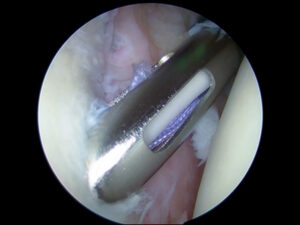
Bone anchors being inserted for repair of the torn labrum and capsule.
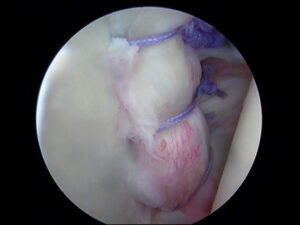
Arthroscopic view at completion of repair.
Open capsular shift procedure
In this procedure, the ligaments of the shoulder capsule are tightened to create a tighter ‘fit’ and thus keep the shoulder joint in place.
This procedure has mostly been replaced by arthroscopic procedures in Dr Reddy’s practice.
Latarjet procedure
Where shoulder instability has occurred over a period of time and there have been repeated dislocations, there may be damage to the socket bone itself, large dents in the head of humerus, or large tears in the capsule.
Arthroscopic stabilisation procedures may have higher failure rates in these situations so Dr Reddy may advise a Latarjet procedure – a bony procedure which has higher success rates.
This procedure involves a bone graft where a small section of bone is removed from another part of the shoulder blade and inserting this into the damaged socket. The small section of bone is attached with screws. This procedure is completed using a 5-6 cm incision in the front of your shoulder joint.
The Latarjet procedure may also be indicated in contact athletes with lax dislocating shoulders and in revision instability surgery. It has a success rate as high as 97-98% with a low complication rate.
Post-operative recovery and rehabilitation
Dr Reddy and the physiotherapist will see you day one following surgery and demonstrate exercises to be performed as well as advise on things to do and not do.
It’s important you follow the advice and rehabilitation guidelines to give yourself the best chance of recovery and an optimal outcome.
- You would likely have a regional / nerve block for pain management apart from a general anaesthetic.
- You would usually stay in the hospital overnight, but this could be longer.
- Please take regular pain medication as advised.
- Apply ice packs five times a day for 10 minutes each time for the first two weeks.
- You will need to wear a sling full time for four weeks, but you can remove it thrice daily for 15-20 minutes each time to perform exercises. Specifically avoid external rotation beyond neutral and active abduction for the first six weeks.
- Please remove the sling for a shower, resting your arm by the side. The dressings are waterproof.
- After four weeks, you can cease using the sling. Progress with exercises as advised by your therapist.
- Strengthening exercises usually start only after three months following surgery.
- Avoid lifting weights and push-pull movements for three months following surgery. The goal is to gradually achieve normal range of movement and strength of the shoulder over a three-month period.
- Driving is permitted only once you come out of the sling and have achieved good control of the arm and a pain-free status. This is usually by the four-to-six-week postoperative period.
- Following an arthroscopic shoulder stabilisation: return to sport is discouraged until six months postoperatively.
- Following a Latarjet procedure: return to sport is usually at three to four months depending on a clinical examination and healing evident on x-rays.
- Please follow your therapist’s advice regarding exercises and follow the rehabilitation guidelines that you can download below.