
Rotator Cuff Repair
The term ‘rotator cuff’ describes four muscle-tendon units that connect the upper bone of the arm to the shoulder blade.
These muscles merge into tendons and this muscle structure allows the arm to be lifted and rotated. Tears or ruptures of these muscles can be caused by trauma, such as a sports injury, a fall, or a motor vehicle accident, but they can also be caused by other factors such as repetitive stress, lack of blood supply, or the growth of bone spurs (called ‘shoulder impingement’).
Tears can be very small or large, and there is seemingly no correlation between the size of the tear and the amount of pain!
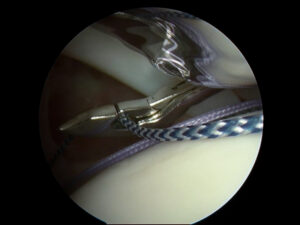
Arthroscopic view of repair of a partial tear of rotator cuff.
Procedure
Rotator cuff repair is usually indicated in one of two situations: an acute traumatic rupture or a chronic symptomatic tear.
A rotator cuff repair procedure can be carried out using conventional open surgery or via arthroscopic ‘keyhole’ surgery or a combination of the two, and is normally performed under general anaesthetic, including an anaesthetic nerve block which helps lessen pain for a 48-hour period.
Adelaide orthopaedic surgeon Dr Sunil Reddy specialises in shoulder surgery and performs most rotator cuff repairs arthroscopically (keyhole surgery) or using a mini-open approach using the latest evidence-based technologies. This allows for less pain, faster rehabilitation, and minimal scarring.
Arthroscopic rotator cuff repair
Arthroscopic or keyhole surgery of the shoulder allows for excellent visualisation of the rotator cuff tear and its repair in a minimally invasive manner. It’s technically demanding but allows for less pain, early rehabilitation, and minimal scars and has equal tendon healing rates as open surgery.
The affected tendons are repaired using small ‘rivets’ or ‘anchors’ which are fixed into the points on the bone where the tendons attach. These anchors are made of material that dissolves over time.
Dr Reddy repairs most rotator cuff tendons using a technique which allows for strong repair and in many published studies has shown higher healing rates.
Specific risks and complications
Dr Sunil Reddy will clarify the benefits, risks, and complications of the procedure prior to surgery.
It’s possible that some pain, stiffness, and weakness may remain or the repair may fail especially where the tears are larger and where the patient is over 65 or is a smoker, or where the postoperative exercise regime is not followed.
Dr Reddy will demonstrate a self-stretching home exercise regimen that is usually started preoperatively. This protocol that is continued after surgery has proven to result in excellent shoulder function and range of motion and decrease the incidence of stiffness.
Postoperative recovery and rehabilitation
Dr Reddy and the physiotherapist will see you day one following surgery and demonstrate exercises to be performed at home as well as advise on things to do and not do.
It’s important you follow the advice and rehabilitation guidelines to give yourself the best chance of recovery and an optimal outcome.
- You would likely have a regional / nerve block for pain management apart from a general anaesthetic.
- You would usually stay in the hospital overnight.
- Please take regular pain medication as advised.
- Apply ice packs five times a day for 15-20 minutes each time for the first two weeks.
- You will need to wear a sling full time for four weeks, but you can remove it thrice daily for 15-20 minutes each time to perform exercises.
- Please remove the sling for a shower, resting your arm by the side. The dressings are waterproof.
- After six weeks, you can come out of the sling to perform gentle activities of daily living. Progress with exercises as advised by your therapist.
- Strengthening exercises usually start only after three months following surgery.
- Avoid lifting weights and push-pull movements for three months following surgery. The goal is to gradually achieve normal range of movement and strength of the shoulder over a three-to-six-month period.
- Driving is permitted only once you come out of the sling and have achieved good control of the arm and a pain-free status. This is usually by the eight-to-twelve-week postoperative period.
- Please follow your therapist’s advice regarding exercises and follow the rehabilitation protocol below.
Learn more about Rotator cuff tears – Visit American Academy of Orthopaedic Surgeons website.
Rehabilitation Guidelines for Arthroscopic Rotator Cuff Repair