
ACL Reconstruction
Dr Sunil Reddy has helped numerous young people return to high level sport and physically demanding work following ACL tears and other ligament injuries to the knee including multi-ligament injuries. He performs arthroscopic anterior cruciate ligament (ACL) reconstruction using single hamstring tendon graft.
He is also skilled and experienced in treating previously failed ACL reconstruction surgeries with Revision ACL reconstruction surgery. Please make an appointment with Dr Reddy by calling 8232 8899 to discuss your knee problem or injury. He will work with you towards formulating a management plan and getting you back on track to an active life.
Dr Reddy strongly believes in preserving the native ACL remnant at the time of reconstruction. It has sub-synovial and vascular elements and fibroblasts that enable and potentially accelerate ACL graft revascularisation, cell proliferation and ligamentisation. He undertook a 12-week fellowship at the renowned Centre Orthopaedique Santy in Lyon, France to refine his skills in Shoulder and knee surgery including his current technique of ACL reconstruction.
Conditions
The ACL runs through the middle of the knee from front to back, along with the posterior cruciate ligament (PCL). Together they form an ‘X’ shape crossing over each other. Their main function is to stop the knee from wobbling forwards and backwards and to stop it from twisting too much.
The ACL can be torn or ruptured in a fall with a pivoting injury or a hyperextension injury of the knee. ACL injuries are common in young people and occur most frequently when playing sports, especially sports like soccer, football, basketball, and skiing. Females are slightly more prone to ACL injuries than males due to differences in body anatomy, muscle strength variations and hormonal factors.
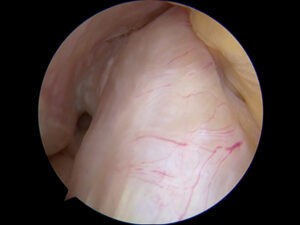
Arthroscopic image of a normal ACL.

X-ray image of ACL reconstruction with short single hamstring graft with button construct fixation on femur and tibia.
Procedure
Dr Reddy performs ACL reconstruction arthroscopically. Once the patient is under anaesthesia, the knee is examined to confirm the ACL is torn and to check if there’s damage to other ligaments in the knee.
The required graft is harvested through a 3-4cm incision before approximately 1cm incisions are made in the front of the knee to allow the arthroscope and other surgical instruments to be inserted. Any damage to the meniscus is addressed before preparing femoral and tibial tunnels for graft fixation.
The surgery usually involves an overnight stay but not always.
Arthroscopic ACL reconstruction – things you need to know
Recovery
Dr Reddy will see you the morning after surgery. He and the physiotherapist will advise you of your exercise regimen as well as things to do and not to do.
You can walk full weight bearing after surgery once quadriceps strength and leg control are regained. A pair of crutches may required for the first week. Twisting, pivoting, and cutting movements. Jumping/landing activities and running on uneven surfaces should be avoided for six months.
It is normal for the area around the knee to have some swelling and pain for 3-4 weeks. Pain medication will be prescribed. Keeping the leg elevated and using ice packs on the knee will help reduce swelling.
The dressings are waterproof so showering is allowed.
Driving is not allowed until complete pain relief and full control of the involved leg is attained. This is usually after four to six weeks for the right knee, but may be as short as two weeks for the left knee with an automatic car.
The healing and graft maturation following ACL reconstructions continues for about one year Return to contact sports is based on functional/sport-specific testing and is usually after nine to 12 months.
Overview of risks
Risks of knee arthroscopic surgery include but are not limited to:
- Nerve injury leading to long-term numbness.
- Blood clots (deep vein thrombosis / pulmonary embolism) in the legs and/or lungs.
- Failure of the graft requiring reoperation.
- Persistent pain.
- Joint stiffness.
- Problems with screws that may be used to fix the graft.
Most patients have an uneventful recovery and progress to full healing with a stable knee.
Rehabilitation guidelines for arthroscopic ACL reconstruction
The timelines mentioned are approximate and actual progression depends on individual recovery.
Patients can weight bear as tolerated from day one. Please use crutches until good pain control, quadriceps strength, and walking mechanics are achieved.
Avoid pillows under knees and focus on knee extension and quadriceps exercises from day one.
Apply ice packs three to five times a day, for 10 minutes each time for the first two weeks.
First two weeks
- Seated knee range of motion exercises.
- Quadriceps sets, hip abductor exercises, core-strengthening and upper body conditioning exercises.
- Static quadriceps exercise is the single most important exercise in the first four weeks following surgery and you are encouraged to perform it in sets of 10-20, five times daily.
- Gait training.
- Wean off assistive walking devices.
Two to six weeks
- Closed chain exercises – start squats, bridge exercise.
- Progress with core-strengthening exercises.
- Stationary bike.
- Functional and activity-based exercises.
Six to 12 weeks
- Add eccentric and lateral training exercises.
- Bike with minimal resistance.
- No cutting or pivoting.
After 12 weeks
- Progress with strengthening and endurance training.
- Low-level jumping exercises.
- Work-specific and sport-specific training.